One-Class Regularization for Cross-Source Malicious URL Detection
Working title, simplified until fully published. The description on this page accurately reflects the actual research, without disclosing implementation-level methodology.
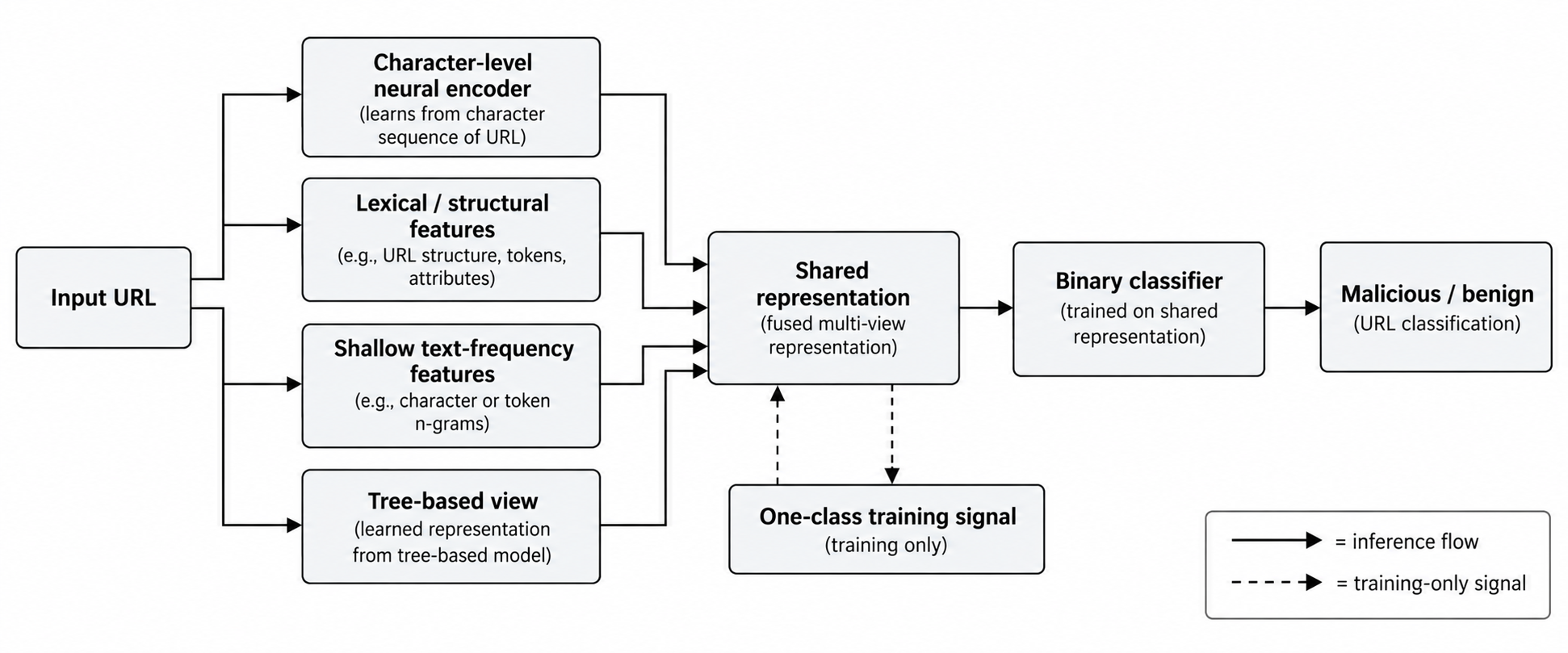
This work extends a multi-view URL representation approach by introducing a support-aware (one-class) regularization term during training, testing whether shaping the learned representation around the geometry of malicious examples can improve detection, particularly at the low false-positive-rate operating points that matter most for real deployment. Evaluated across two independent public URL datasets, the approach shows a modest but consistent shift in error patterns compared to a matched control, and reveals a strongly asymmetric transfer pattern between the two datasets.
URL-only screening is valuable because a decision can be made before a destination is ever visited. But public URL datasets often contain collection artifacts and infrastructure overlap that let models exploit superficial provenance signals rather than genuine malicious characteristics, meaning same-source benchmark scores can look misleadingly strong.
Building on an existing multi-view URL representation approach, this research asks whether adding a one-class training signal, one that shapes the geometry of the learned representation around malicious examples, rather than acting as a separate anomaly detector, changes what the model actually learns. The experimental design holds everything else fixed between a treatment and control model, so any difference can be attributed specifically to this added signal.
Average performance differences were modest, but a closer, example-level look revealed a much larger shift underneath the surface: many individual predictions changed, predominantly correcting one specific category of error rather than uniformly moving every prediction. At the low false-positive-rate operating points most relevant to real deployment, the approach also showed a measurable gain over a strong non-neural baseline.
A strict transfer experiment, training on one dataset and testing on a completely separate one, with no adaptation, found performance highly asymmetric depending on the direction of transfer. This reinforces a broader theme across this line of research: strong same-source results do not guarantee a detector's learned signal will generalise, and evaluation protocol matters as much as model architecture.
Full methodology, results, and the underlying paper are not disclosed here, as this research is intended for conference submission and/or currently under review.